
In the previous post, we noted that Abram was born and raised in a pagan culture. His ancestors, his father, and his brothers worshipped other gods, but Abram was called away from his family to a new land. “Now the Lord had said unto Abram, Get thee out of thy country, and from thy kindred, and from thy father’s house, unto a land that I will shew thee.” (Genesis 12:1)
This land that God promised Abram, afterwards known as “The Promised Land”—Canaan—would not only be Abram’s home from this point forward, but would also be home to his descendants. At this point, though, Abram had no descendants. In Canaan, Abram and his family would begin a new life where they worshipped the God of Creation, YHWH, rather than the pagan gods of his father and brothers and the Canaanite people in the land he went to possess. Because Abraham faithfully obeyed YHWH, he and the generations that followed were blessed because of his obedience. “And I will make of thee a great nation, and I will bless thee, and make thy name great; and thou shalt be a blessing.” (Genesis 12:2)
Can you imagine leaving a bustling, prosperous city such as Ur to move to an unknown land? Even though it may seem difficult to us, we would have moving vans and other mechanical means for transporting ourselves and our belongings from one place to another. It is likely that Abram and his family did a lot of walking and, perhaps some riding on camels. “And Abram took Sarai his wife, and Lot his brother’s son, and all their substance that they had gathered, and the souls that they had gotten in Haran; and they went forth to go into the land of Canaan; and into the land of Canaan they came.” This must have been a sight to behold! Abram and his family did not merely consist of three people, Abram, Sarai, and Lot, but also many personal servants, and herds of livestock, as well as all of their possessions strapped onto the backs of animals and pulled in carts of wagons. This “caravan” must have been quite large in order to transport everything they possessed as well as carry tents and poles and so forth for all of the people to dwell in.
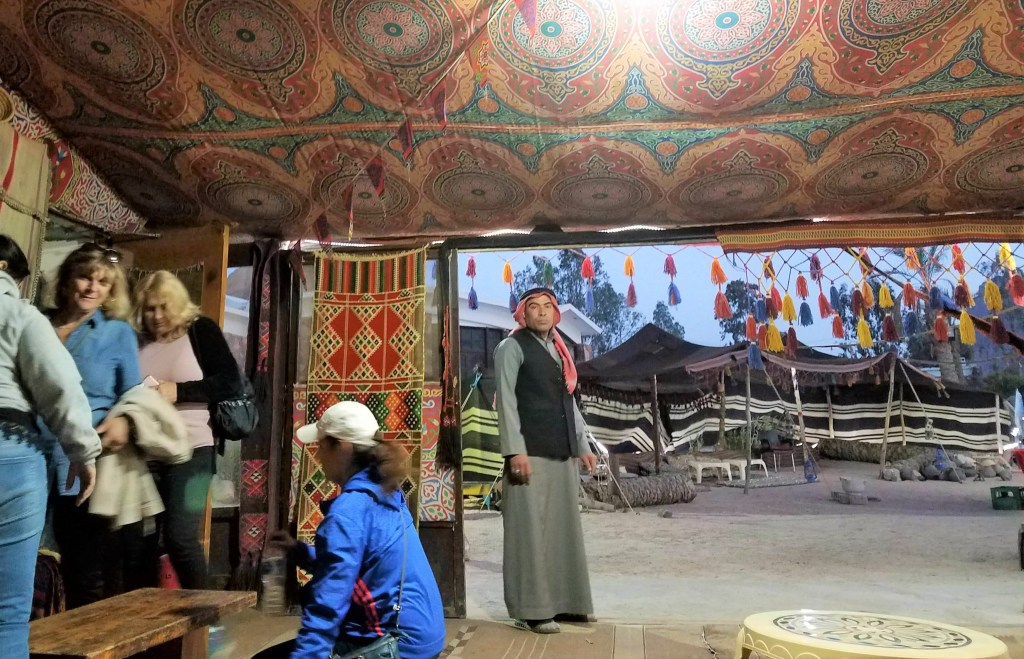
The tents of Abram’s day were probably very similar to those of Bedouin tribes today. Coming from the same region and following ancient traditions, the Bedouin people are nomadic and move from place to place seasonally. In order to facilitate this lifestyle, they are tent dwellers. Their tents are not at all like a tent such as we might use for camping. These tents are (and were) traditionally quite large and spacious inside, with more than one room and big enough to entertain and sleep many people. The tents were supported with wooden poles around the outside and in the middle and the coverings were layered and wisely chosen to not only keep heat in during cold weather but also keep out the heat in hot weather. The outermost covering was skin that kept the inside dry. In the Arabian peninsula, we had the opportunity to visit a colorful traditional Bedouin tent with our tour group of approximately fifty people. Everyone was seated comfortably on low couches and enjoyed dinner together.
Given these few details, perhaps you can imagine that moving Abram’s entire family was slow and cumbersome. But when he and his caravan reached the land of Canaan and moved along the Jordan River Valley, Abram gave Lot first choice of the area in which he and his people would dwell. “And Lot lifted up his eyes, and beheld all the plain of Jordan, that it was well watered everywhere before the Lord destroyed Sodom and Gomorrah, even as the garden of the Lord, like the land of Egypt as thou comest into Zoar. Then Lot chose him all the plain or Jordan; and Lot journeyed east;” (Gen 13:10-11). What Lot beheld seemed like Eden to him, and he chose for himself what looked to be the most beautiful, without considering the inhabitants of this land. “But the men of Sodom were wicked and sinners before the Lord exceedingly.” Gen 13:13. Lot seems to have been very shallow, considering only the appearance of the area, and he had first choice over his uncle and elder, Abram.
Abram on the other hand, choose to go in the opposite direction from Lot, or to the west. “Then Abram removed his tent, and came and dwelt in the plain of Mamre, which is in Hebron, and built there an altar unto the Lord. Abram wasn’t as concerned with the appearance of the land. He apparently realized that what mattered most was His relationship with God, as the first thing he did was build an altar to worship. Abram’s character reveals much about his relationship with God and the deep abiding faith that led him to accept the land that was less beautiful in appearance, but more like what our Lord himself would have chosen. And so, the promised possession became a blessing to Abram and Abram became a blessing because of his obedience, and God promised to give him descendents.
The character of these two men and their family reveals a lesson well worth remembering. While Lot sought after physical beauty and comfort, Abram sought spiritual beauty and comfort, and the Lord blessed him. Lesson #3, then: The charms of this world are powerful but fleeting. Terah, Lot, and Lot’s wife, as we soon will see, all seemed to fall for them.
 From Peggy's Pen
Thank you , that was great to read. Lynne Warnock
LikeLike
Thank you, Lynne, for reading and commenting!
LikeLike