How to Pray, Part III

In the first two parts of this discourse on how to pray, we have seen that prayer is not a memorized script, but is a conversation that is achieved only through developing an intimate relationship with God. It begins with praise and worship and puts our personal requests in the latter part of the conversation, ending with a request to protect us from temptation and deliver us from evil, and asserting that God’s kingdom, power, and glory are eternal. Most would agree on these points in prayer, but many differ widely on their views about hearing God’s voice conversing with us in response.

Does the Bible actually teach that God speaks to us? If so, how does He speak to us? And through what “ears” do we hear His voice? And finally, why don’t we all hear Him?

Does the Bible teach that God speaks to us?

This question has often been asked, particularly by those new to the faith, but also from those who have been believers for many years, and the answer may surprise you. Yes, the Bible teaches that God speaks to us. The main reason this question is so often asked and is sometimes perplexing, even to students of the Bible, is that the scriptures on this topic have not been widely taught. The late Charles Spurgeon said, “Holy Scripture requires searching—much of it can only be learned by careful study.” The second reason that students of the Bible and others are perplexed about whether or not God speaks to us is that these truths have not been put into daily practice. What, then, does the Bible say about God speaking to us? Let’s start at the very beginning in Genesis and see what the Bible has to tell us.

The Creation Voice

Genesis 1:3 reads, “And God said, Let there be light!” God SPOKE light into existence. Verse 1:6 reads, “And God said,” showing God speaking again. Verse 1:9 repeats, “And God said,” as do verses 1:11, 1:14, 1:20, and so on. All of God’s magnificent work of creation took place at His command—through words! Pause here and reflect on this while we turn to another scripture in the New Testament.

John 1:1 reads, “In the beginning was the Word, and the Word was with God, and the Word was God.” And verses 3-5 of John 1 further explains, “All things were made by him; and without him was not anything made that was made. In him was life; and the life was the light of men. And this glory, the light shineth in darkness; and the darkness comprehended it not.”

Photo by Jill Burrow on Pexels.com

Paul confirms this truth, saying, “For by Him were all things created that are in heaven, and that are in earth, visible and invisible, whether they be thrones, or dominions, or principalities, or powers: al things were created by Him and for Him.” (Col 1:16) And in Hebrews 1:2, Paul* wrote, “Hath in these last days spoken unto us by His Son, whom He hath appointed heir of all things, by whom also He made the worlds.”

Further John explains in John 1, verse 14, “And the Word was made flesh, and dwelt among us, and we beheld his glory, the glory as of the only begotten of the Father, full of grace and truth.” And finally, in John 1:17, “For the law was given by Moses, but grace and truth came by Jesus Christ.”  

There you have it. The identity of the voice!

Jesus is the Word. (John 1:1, 1 Cor 8:6, Col 1:16)

Jesus is “the only begotten of the Father,” (John 1:14).

Jesus was in the beginning, and is now, with the Father (John 1:1).

Jesus is “the life and light of men,” (John 1:4).

Jesus is the ONE who spoke all of creation into existence. (John 1:1, Genesis 1)

Jesus, the son and the second part of the triune Godhead, is the voice of creation. (John 1:3, Heb 1:2)

Understand this concept and you will shed the “darkness that comprehended it not” (John 1:5) and begin to understand the voice of God.

The Preincarnate Voice

Jesus is the Word that spoke into being all of creation. John said, “All things were made by him,” (John 1:3), but He was speaking on the command of the Father. Jesus is the voice of creation! Jesus spoke everything that the Father had thought of into existence. Then, Jesus continued speaking to His creation. Jesus not only spoke directly to the disciples during his incarnation, and after he had arisen from the grave, but he also spoke to Adam and Eve, Abraham, Noah, Moses, and others in preincarnate visitations. This is easier to comprehend when we consider that Jesus is not limited by time, space, and form in speaking to his people. Jesus, the creator of all, transcends matter, time, forces, and all of creation and has all power over it.

In the beginning, Jesus in a pre-incarnate form appeared on earth and spoke to Adam and Eve, walking in the garden (Gen 3:8). “And they heard the voice of the Lord God walking in the garden in the cool of the day: and Adam and his wife Eve hid themselves from the presence of the Lord God amongst the trees of the garden.” (Note that the name “Lord God” is first used here and is a personal name for God that Adam and Eve are using, indicating a personal relationship. Also note that they heard the Lord God’s voice calling them as He walked in the garden, again indicating a physical presence.)

Jesus in pre-incarnate form visited Abraham with two angels. Genesis 18: 1 says, “And the Lord appeared unto him in the plains of Mamre and he sat in the tent door in the heat of the day. And he lift up his eyes and looked, and lo, three men stood by him; and when he saw them, he ran to meet them from the tent door, and bowed himself toward the ground.” (Gen 18: 1-2) Jesus not only walked with Abraham, but also sat down to eat with him (Gen 18:8), promised him a son (Gen 18:10), and warned him of the doom of Sodom and Gomorrah (Gen 18:20-21). “And he took butter, and milk, and set it before them; and he stood by them under the trees, and they did eat.” (Gen 18:8) This activity of eating and drinking, sitting and talking, again indicates a physical presence.

The Bible also records the times Moses met with the Lord in preincarnate form. Jesus also spoke extensively to Moses in the form of the burning bush (Exodus 3:2-4:17), a different but physical presence. He also spoke to Moses on Mt. Sinai: “And when the voice of the trumpet sounded long, and waxed louder and louder, Moses spake, and God answered him by a voice.” (Exodus 19:19).

There are other scriptures detailing how Jesus appeared and spoke to other people such as Hagar, Balaam, Jacob, Gideon, Manoah, and so on. These events are recorded in scripture so that we will know and understand how God speaks to us through Jesus, the Word. Scripture tells us that no one has seen the Father except the Son (John 6:46), and that no one has heard His voice. “And the Father himself, which hath sent me, hath borne witness of me. Ye have neither heard his voice at any time, nor seen his shape.” (John 5:37) So the voice people have heard was none other than the voice of Jesus!

The Resurrected Voice

Did Jesus still speak to people after he died and was resurrected? Yes! He appeared in a visible form and spoke out loud to Mary Magdalene (John 20:14-16) just after he had arisen from the grave. “Jesus saith unto her, ‘Woman, why weepest thou? Whom seekest thou?’ She, supposing him to be the gardener, saith unto Him, Sir, if thou have borne him hence, tell me where thou hast laid him, and I will take him away. Jesus saith unto her, ‘Mary.’ She turned herself, and saith unto him, Rabboni, which is to say, Master.” (John 20: 15-16)

He also appeared to Mary, Salome, and Joanna (Matt 28:9), Peter (Luke 24:34) ten of the disciples (John 20:19), the eleven, including Thomas (John 20:26-28), James (1 Cor 15:7) a large gathering of over 500 (1 Cor 15:6), Cleopas and one other, perhaps Simon, on the road to Emmaus (Luke 24:13-32), on the Sea of Galilee, and more.

The Post -Ascension Voice

Did the voice stop once Jesus had ascended into heaven? No. Has he spoken to his people since then? Yes! Jesus spoke to Paul in a post-incarnate form from a cloud when Paul and his entourage where on the road to Damascus (Act 9:3-5). Paul and all of his entourage heard the voice, although only Paul understood the message, as it was meant for him. Experts differ on their explanations of this vision, but most agree that Paul saw Jesus in heaven as a vision, but audibly heard His voice on the road. This vision is somewhat similar to John’s experience on the Isle of Patmos when he received the revelation of what is to come in the end of time. John wrote that he heard a voice behind him, and he saw a vision of Christ in glory, “clothed with a garment down to the floor, and girt about the paps with a golden girdle. His head and his hairs were white like wool, as white as snow, and his eyes were as a flame of fire. And his feet like unto fine brass, as if they burned in a furnace; and his voice as the sound of many waters.” (Rev 1:12-15) John later wrote that he was taken up into heaven. Both Paul and John experienced lack of physical control as they fell flat on the ground. Luke wrote of Paul (then Saul), “And as he journeyed, he came near Damascus; and suddenly there shined round about him a light from heaven: and he fell to the earth, and heard a voice, saying unto him, Saul, Saul, why persecutest thou me?” (Acts 9:3-4) And John described his lack of physical control at seeing Jesus in a vision, “And when I saw him, I fell at his feet as dead.” (Rev 1:17)

Please return here to continue reading the next section, Part IV, on how God speaks to us today and why some don’t hear His voice.

The Substitute Quandary

Do you remember when you were in grade school and you had a substitute teacher? Things in the classroom never went quite as planned on those days. The substitute had to read over all the plans the teacher left for the day, and she would inevitably miss some little detail or mix up the schedule. The class bully would deliberately try to confuse her, and the star student would tattle on him.  It often made for a day light on work and heavy on the giggles for the students. It was clear that the students didn’t place as much significance on the presence of a substitute as they did on the actual teacher. But the substitute was equally important, and in some cases, probably more important, because class could not go on if she (or he) had not been there.

When I was a teacher, no matter how sick I was, it was easier for me to show up and teach my class than to plan for a substitute. The reason was that I had so many things I couldn’t put in writing. Notes about each student, notes about what to do in the event of this or that. How to handle such and such.

Sure, I could leave written plans and tell the students to behave for me. But it was never the same. Plus, it was twice as much work to prepare.  I had too many details in my head. It was simpler just to come to class sick unless I simply couldn’t get out of bed.  

But substitutes are necessary sometimes.

Consider algebra, for instance. How could you ever solve an equation for the unknown variable without the substitute x, y, or z?

Every good cook knows substitutions for common items, such as substituting whole milk and butter for heavy cream or arrowroot for cornstarch.

In English, we have a refined method of substituting for an unknown word. In place of the unknown, we simply say, “one,” as in, “One cannot help but laugh at a joke on oneself.”

Or, we use a pronoun, as in “Jack and Jill went up the hill, and then they fell down.”

In the world of childbearing, we’ve even figured out how to have one mother substitute for another, as in a surrogate mom.

In the case of my class, I knew how difficult it was for someone to step in and follow my plans, not knowing how the order of the day proceeded normally. It was a challenging, often thankless job. The substitute was required to put aside her normal routine to adopt the routine of another. What a sacrifice that can be, even for someone acquainted with the procedures. And I rarely ever saw the substitute who took my place to thank her!

The most important example of a substitute, and one of the most difficult for us to understand, is that of our Lord and Savior, Jesus Christ. By dying on the cross in our place, he became the sacrificial lamb that would take the place of our own death for our sins, providing redemption for all who would believe in Him. Without his substitutionary death on the cross, we would all die in our sins, but because of sacrifice, redemption is now possible for all who believe.

If we wrote an equation for this formula, it might look something like this:

If x=death of Christ, y=belief, and z=salvation, we can say that x + y =z,

or, the death of Christ added to our belief in Him equals salvation.

So many today do not comprehend the meaning of this equation. It’s a rarity that someone comes to the realization that he or she is a sinner and that sin, any sin, brings with it the death penalty. It’s an even greater occasion when a sinner realizes the enormous sacrifice that Jesus made by leaving his throne of glory in Heaven to take our place in the most horrific death of all—on the cross—for us! Hallelujah for our substitute! What a Savior who died for us!

How to Pray, Part II

Praying Intimately

We have considered how effective prayers follow a formula that begins with adoration, prays for God’s kingdom to come and His will to be done, asks for our needs to be met, requests protection from temptation and evil, and seeks forgiveness from sins. This was the model that Jesus taught his disciples to follow, and it’s meant for us, as well. But this formula for prayer, known as the Pater Noster, or  “The Lord’s Prayer,” (Matt. 6:9-13) is a model, not a memory verse to repeat over and over in place of having a conversation with the Creator of the Universe.

You might be shocked at the word, “conversation,” but it was a deliberate word choice. When we pray, we do have a conversation with our Father. A conversation is a meaningful exchange of thoughts and ideas between two or more individuals. It implies openness and intimacy.

Let’s consider, then, how to make our prayers more open and intimate. Is it truly possible to have an intimate conversation with God? Scripture tells us that God’s ways are not our ways and His thoughts are not our thoughts. “For as high as the heavens are higher than the earth, so are my ways higher than your ways, and my thoughts than your thoughts,” the Bible says. (Isa 55:9)

Intimacy means a close relationship between two individuals who have an affinity for each other. It implies a deep, abiding friendship, trust, and companionship. Is that kind of rapport possible between humans, who wither like the grass, and the Almighty, Infinite, Omnipotent God? Indeed it is, praise God!

Intimacy Begins with Trust

Let’s face it. No relationship exists without trust. As soon as trust breaks down, the relationship breaks down. We see trust destroyed all around us—when political leaders place corporate donations above community, when business leaders seek profit above performance, when education systems seek public support over scholarship, and so on. Trust can be broken in a variety of ways—infidelity, lies, evasion, physical distance, and more. The bottom line is that trust depends on putting a loved ones’ needs above your own. The same applies in our relationships with God. We must draw close to Him, and honor Him first. And wonder of wonders, when we do, despite whatever it is that has kept us away from Him, He will draw near to us!!

James 4:8 advises, “Draw near to God and He will draw near to you. Cleanse your hands, you sinners; and purify your hearts, you double-minded.” Rev 3:16 also warns about being double-minded: “So, because you are lukewarm, and neither hot nor cold, I will spit you out of my mouth.” Double-minded means wavering, unsteady, flitting back and forth between two sides. A double-minded believer is not committed.  James is telling us that when we are not committed to our relationship with Him, when we put our own needs first, when we disobey Him, we break trust with Him. It’s just as if we are committing adultery! Cheating on God is definitely a trust destroyer and is one of the fastest ways to break a relationship. How many marriages have crumbled once trust flew out the window? Our relationship with our beloved God is no different.

Just as a husband or wife who is not committed to a marriage is a partner who is in danger of infidelity, so is a “believer” who is not committed to God. In fact, a committed believer is someone who is so firm in the faith that he or she is sharing the heart and mind of Christ. If you are in danger of being double-minded, wavering in your faith, James advises to “purify your heart,” and “cleanse your hands, you sinners.” This is an attitude of repentance, and an attitude that God will not reject, unlike those who won’t admit their weaknesses and wrong-doing.

Intimacy Requires Respect

When Frank Sinatra wrote the song, “All or Nothing at All,” in 1939, I don’t think he had God on His mind, but the lyrics perfectly describe the kind of respect God is seeking from us. Sinatra wrote,

“All or nothing at all
Half a love, never appealed to me
If your heart, never could yield to me
Then I’d rather have nothing at all.”

This is the type of relationship we should have with God—an all or nothing relationship. This type of relationship requires respect and commitment, but it also requires high esteem for the Great I Am, and admiration and respect for the relationship such that we recognize that we are but dust and God is Almighty and is more than worthy of our praise. Why He would want to have a relationship with us staggers the mind, but He does, and this fact alone requires our respect and reverence. We must be willing to put our needs, our interests, our wants aside and put God’s desires in their place. A miraculous thing happens when we do—He gives us the desires of our hearts! David wrote in Psalm 37:4, “Delight yourself also in the Lord, and He shall give you the desires of your heart,” and also in Psalm 21:2, “Thou hast given him his heart’s desire, and hast not withholden the request of his lips. Selah.”

However, the Bible also warns about receiving desires without appreciation of these blessings and a reciprocal response in return. Deut 9:6 says, “Know, then, it is not because of your righteousness that the Lord your God is giving you this good land to possess, for you are a stubborn people.” And Prov 29:1 warns, “A man who hardens his neck after much reproof will suddenly be broken beyond remedy.”

Intimacy is Strengthened with Honesty

Just as lies and evasion can break down a relationship with other people, lies and evasion can break down our relationship with God. Have you been keeping something hidden from God, even though you know He knows because He is omniscient? This is dishonesty and it is a barrier to intimacy. Bare it all before God. When you bare your heart to God, you are allowing Him to access every part, even the hidden corners, of your heart. This is the opposite behavior of the Israelites, who hardened their hearts toward Him.  Only when you have confessed everything to Him can He enter into the deepest hurts and heal them, and only then can true intimacy develop between you. Once you have bared your heart, and opened it to God, the Holy Spirit can enter and begin to work on rebuilding and refashioning your heart of stone after the heart of Christ. “And I will give you a new heart, and a new spirit I will put within you. And I will remove the heart of stone from your flesh and give you a heart of flesh,” God promised in Ezekiel 36:26. Having a heart like Jesus is a sure path to intimacy with God, but it requires you to take the first step—to move toward God, or make a sincere effort toward building an abiding relationship with Him.

Intimacy Requires Effort

Consider how much work you put into a human-to-human relationship. You call each other, compliment each other, spend time with each other, even when you don’t want to. You’d give up your plans to be with someone you care about, right? Let’s face it, maintaining a relationship takes work. How many of us WORK at a relationship with God? It takes time that is prioritized for Him, not last minute, falling asleep, I’ll- do-better-next-time moments. Think about when you were first dating someone. How long did it take you to get ready for a date? It takes effort to prepare yourself for a meeting with God, too. Don’t get me wrong. There are those spur-of-the-moment times when you’re sitting in traffic or when you get THAT phone call and you must pray–immediately. But generally speaking, your times with God should be planned and you should prepare for them. Think of the Israelites who had to prepare for three days before God came down to Mt. Sinai to address Moses. They had to wash their clothes, bathe their bodies, refrain from sexual relations, and prepare to meet with God. These preparations were to show the Israelites that God was holy and required them to be holy, or set apart. Changing their normal activities were to demonstrate that they were to shift their focus from the everyday, or mundane, activities to the spiritual things of God. Their preparations were a foretaste of the future sanctification that would be awarded all believers.

Take a moment and consider all of those whose lives matter to you and how you change your routines for them, sometimes daily. If one of them called, wouldn’t you drop everything and respond? How much more our Father, who loves us beyond our imagination, will drop everything when we call, if we make Him a priority in our lives—if we maintain our relationship with Him, but we must put forth the effort to prepare to meet with Him and our efforts will be rewarded.

Intimacy Elicits a Response

One of the most wonderful truths is revealed when you become intimate with God: your openness, brokenness, intimacy elicits a response! Your prayers are no longer one-sided, venturing into the great beyond with no answer. Wonder of wonders, the Great I Am hears and answers the humble, broken, and open prayers just as Jesus promised in the Sermon on the Mount. “Blessed are the pure in heart, for they shall see God,” Jesus taught. (Matt 5:8) What he meant by this was that those who had been transformed to have a heart like his, would be able to enjoy communion with God. They, like Jesus, would enjoy fellowship unbroken by sin because their sin was covered and their hearts were made clean, washed in the blood of the lamb. And their prayers, like the prayers Jesus prayed, would always be heard and answered, because God sees them as He sees their sacrificial lamb, and because once they are indwelt with the Holy Spirit, he would make intercession for them even if they didn’t know what they should pray.

Isn’t this a glorious thought?

To continue reading Part III, click here: https://wordpress.com/post/frompeggyspen.com/139

How to Pray

Part 1

Is there a formula for prayer? The disciples wondered if there was. They begged Jesus, “Teach us to pray.” (Luke 11:1) Things haven’t changed much since then. If you peruse the titles of bestsellers through the years, it would seem that we are still searching: How to Pray by C.S. Lewis, Pocket Prayers by Max Lucado, The Power of a Praying Wife (and others in the series)by Stormie Omartian, Praying God’s Word by Beth Moore, Too Busy Not to Pray by Bill Hybels, and more. Two thousand years later, we are still looking for the right way to pray.

Of course, many religious leaders and teachers believed that they knew the right way to pray, but were totally wrong. Jesus berated these hypocrites for praying publicly on the street corners. “And when thou prayest, thou shalt not be as the hypocrites are: for they love to pray standing in the synagogues and in the corners of the streets, that they may be seen of men. Verily I say unto you, they have their reward,” (Matt 6:5 KJV) he said, meaning that they were rewarded by the crowds of people observing them.

Jesus taught us instead that we should “..enter into thy closet, and when thou hast shut thy door, pray to thy Father which is in secret; and thy Father which seeth in secret shall reward thee openly.” (Matt 6:6 KJV) Nothing is hidden from our Heavenly Father, who sees our private lives as well as our public lives, and He will hear the “effectual, fervent prayer of a righteous man,” that “availeth much.” (James 5:16).

But there’s more. Jesus also taught us a model for prayer…one that always resounds with our Father. This model was not a list of words for us to parrot back in prayer, but was meant as a guide to follow with our individual and personal prayers.

This is how it goes.

Photo by Pixabay on Pexels.com

Begin with Adoration

When Jesus taught the Lord’s Prayer, he began with “Our Father, who art in heaven, hallowed be thy name.” The first two words, “Our Father,” are bursting with significance. First, the word, “our,” refers to more than one person, or a group, a group of people—us. All of us. God is the god of all of us. Our God is our Creator, our redeemer, and our hope of eternal life–one God for all of us.

“Father” is a term of authority as well as endearment. God is our supreme authority, but also our Abba, our loving Father.  What an amazing thought! The Creator of the Universe, the Supreme Authority in all Creation, is also our loving Father!

The words, “Who art in heaven,” indicate his abode above us, but also that he is differentiated from our human fathers, although human fathers may be likened to him. The Bible tells us about heaven, but much of it is unfathomable to eyes that have never seen and ears that have scarcely heard of its glory.

“Hallowed be Thy name,” indicates that we, too, should begin with hallowing our Father, who is so worthy of our praise. “Hallow” means holy, consecrated, and revered. God’s name is holy and He is holy—He is perfect in all His ways. He alone is worthy of adoration, for we are imperfect and not worthy of any praise. The mention of His name should bring us to our knees in worshipful reverence. Ps 99:5 says, “Exalt the Lord our God and worship at His footstool; Holy is He.” This psalm is commonly attributed to David. We may not know how to adore the Lord our God in a way that is worthy of Him, but David certainly did. The psalms are full of his exaltation! Ps 145:1-3 says, “I will exalt you, my God the King; I will praise your name for ever and ever. Every day I will praise you and extol your name for ever and ever. Great is the LORD and most worthy of praise; his greatness no one can fathom.” We will do well to follow David’s example.

Solicit His Perfect Will

Jesus continued the Lord’s Prayer with “Thy kingdom come, Thy will be done, on earth as it is in Heaven.” Seeking God’s will above all else is a top priority, but also seeking to mirror the sinless state of heaven in our own lives is also critically important. This will keep us on the right road—the path of righteousness. It takes faith and obedience to seek this path.  It’s crucial to note that God’s will is perfect and that He has plans we do not know about and sometimes cannot fully understand. God is diligently building His Kingdom. When he inserted the phrase, “Thy kingdom come,” Jesus understood that we might not fully comprehend the logistics of this kingdom, but He added, “on earth as it is in heaven, so we would understand that we should still seek to obey as all the heavenly host obey.

Note that Wikipedia claims some ancient authorities translated this to say, “Thy Holy Spirit come upon us and cleanse us.” While we don’t see that in many translations today, it, too, is a worthwhile request to make!

Ask for our Needs to be Met

Jesus taught us that there is a hierarchy for making our requests. Only after praising and asking for God’s will to be done, should we ask for our own needs to be met. It can be difficult for us to fathom where our needs fall in the universal hierarchy of life, but the Bible tells us that God has our needs in mind as well as what is best for us. Our best interests may take some time to realize. When our beloved dies, when we are living with cancer, when a child is stillborn, we can scarcely see beyond our present pain. Paul taught that “…now we see through a glass, darkly; but then face to face: now I know in part; but then shall I know even as also I am known.” (I Cor 13:12 KJV) I believe that Paul meant one day all of our past will be clear to us and we will understand. Prov 16:4 tell us that, “The Lord hs made everything for its purpose,”  even though we may not comprehend what that purpose is. What’s more, Matthew 6:34 says, “Therefore do not worry about tomorrow, for tomorrow will worry about itself. … Each day has enough trouble of its own.” This means that we also only need to ask for one day’s need at a time. We have no guarantees of tomorrow and the satisfaction of today’s needs are enough. “Give us this day our daily bread…” speaks of asking for one day’s provision at a time.

Ask for Forgiveness

“And forgive us our trespasses as we forgive those who trespass against us.” Modern Bible translations often use the word, “debts,” but most older versions use the word, “trespasses.” There is a meaningful difference in the two words. A trespass means overstepping a boundary, whereas a debt is something that is owed. There is no denying that we owe everything, including our very lives, to Jesus Christ, but we are all trespassers. We have overstepped the boundaries God set for us daily, and often deliberately. We are without excuse as trespassers and must plea for forgiveness. In this world where everyone has debt—home mortgages, car loans, credit card bills, and more—debt is considered pretty commonplace. The result is that using a word such as “debt” seems to convey a lesser meaning than the original translation of “trespass.” Make no mistake about the meaning Jesus intended. We are sinners and cannot pay our sin debt ourselves. Jesus added, “as we forgive those who trespass against us.” The measure with which we offer forgiveness to others is the measure that forgiveness will be offered to us. Oh, but we are slow to forgive and may harbor a grudge for years! May God be merciful unto us and forgive us for this, too, and help us to forgive others who are sinners just as we are!

Ask for Protection

“And lead us not into temptation,” needs little explanation. No one wants to be tempted, but we are all guilty of succumbing to temptation. Only Jesus was able to overcome the tempter’s snare. But we can learn from His example. He diverted every tactic Satan used to tempt Him with scripture. The better we know the Holy Word, the better we are able to stand against temptation.

“But deliver us from evil.” Evil will be a part of life until the evil one is ensconced in hell forever, but as long as we are alive on earth, we need not fear it, for God has not only promised to send his angels to protect us (Ps 91:11) but to also keep us and deliver us from all evil (Ps 121:5-7). Perhaps one of the most comforting passages reassures us that the devil will flee from us if we submit to God and resist the devil (James 4:7).

End with Praise

Psalm 22:3 tells us that our Father is exalted with our praise and inhabits the praises of His people. And He is due all of our praise, forever. So, don’t hold back. The psalms are full of beautiful examples of praise, such as Ps 145: 19: “My mouth will speak in praise of the LORD. Let every creature praise his holy name for ever and ever,”and Psalm 8:9: “Lord, our Lord, how majestic is your name in all the earth.” There is no end to the things we can praise God for. It might do well to memorize Ps 150 and say it until it resounds in your heart: “Praise ye the Lord. Praise God in his sanctuary: praise him in the firmament of his power. Praise him for his mighty acts: praise him according to his excellent greatness.  Praise him with the sound of the trumpet: praise him with the psaltery and harp. Praise him with the timbrel and dance: praise him with stringed instruments and organs. Praise him upon the loud cymbals: praise him upon the high-sounding cymbals. Let everything that hath breath praise the Lord. Praise ye the Lord.”

Closing

The final phrase, “For Thine is the kingdom, and the power, and the glory forever,” Is considered a benediction, or a blessing. We are indeed blessed if we are members of the family of God, whose kingdom is without end, for that means we will enjoy His presence and further blessings throughout eternity.

This phrase was not included in the oldest translations but seems to have been added at some point.

The word, “Amen,” is translated, “so be it.” It implies not only that we are finished praying, at least temporarily, but also that we believe that our prayers have been heard and will be answered. It is a statement of faith and trust.

God delights in the prayers of His people. He hears us even when we don’t know the right words of how to ask for what we need. He knows our innermost thoughts, so nothing is hidden from him. Talk to Him and He will respond to you. The more you pray, the better you will know Him, and soon you will learn to discern His whispers and gentle nudges guiding and directing and blessing you.

Read Part II here: https://frompeggyspen.com/2021/05/30/how-to-pray-part-ii/

A Web of Wonder

If you have ever studied a spider web closely, you may have noticed the intricate pattern of silk lines circling out from the center. Spider webs can be minute or huge, depending on the spider and the connecting points of the web. We once had a huge spider build a web in the bushes in front of our house that connected to the gutter on the roof! After a few days of wondering what to do about this enormous, intimidating spider and web, a tornado passed through our area and blew it away.

Photo by Pixabay on Pexels.com

Scientists have recently uncovered some surprising facts about spider webs. According to treehugger.com, spider silk is lighter than cotton and 1000 times thinner than human hair, but is strong and highly elastic, even in blistering temperatures up to 40 degrees below Celsius. What’s even more surprising, “researchers are slowly coming around to the idea that spider webbing is an essential part of these creatures’ cognitive apparatus. The animals don’t just use their webs to sense with; they use them to think!” (https://www.treehugger.com/spiders-web-part-its-brain-suggests-new-research-4859403)

Obviously, more research is needed to explain exactly how spiders use their webs to think, but we do know that humans also use webs to help them think, because a “web” of facts is a commonly used tool for organizing information. For example, a familiar web that most everyone has seen and used is a family tree. When researching your ancestry, a family tree is most helpful in keeping relatives from both parents organized as well as siblings, cousins, aunts, uncles, grandparents great-grandparents, and so on.

When I was a teacher, we taught students to develop concept maps to deepen their understanding. A concept map is a web of bubbles that are connected to a central point and builds outward from it. It’s a type of graphic organizer; that is, a graphic representation or ideas, or a web. There are many types of these graphic organizers. Many templates are available online and lots of apps are available for customizing your own. Here’s one example.

The point of this illustration is to help you visualize a tool for building deep understanding of scripture. You can take a verse or passage and expand on it with various interpretations, definitions, commentary, illustrations, references to similar verses, and your thoughts and questions to help your mind deepen connections and ensure recall.

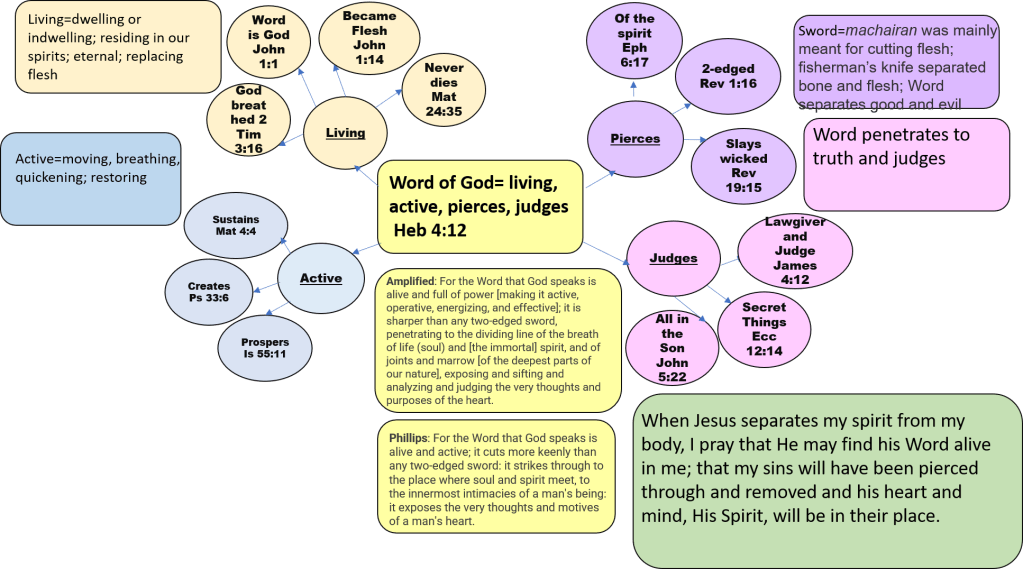
Here’s a concept map of Heb 4:12: “For the word of God is living and active. Sharper than any double-edged sword, it pierces even to dividing soul and spirit, joints and marrow. It judges the thoughts and intention of the heart.” To web this verse, let’s consider how to organize our thoughts. We might highlight some of the key words, such as “living,” “active,” “pierces,” and “judges,” to help us think through how scripture meets these descriptions. We could begin by identifying synonyms or definitions for each word, listing the original word and its translation, finding similar verses since scripture interprets scripture, locating authoritative commentary, and finally, recording our thoughts and questions.  A web for this verse, then, might look like this:

Try out this verse for yourself or any verse for which you wish to deepen your understanding. May God grant you a rich and deep and wide window of study!

The Substitute Quandary

Do you remember when you were in grade school and you had a substitute teacher? Things in the classroom never went quite as planned on those days. The substitute had to read over all the plans the teacher left for the day, and she would inevitably miss some little detail or mix up the schedule. The class bully would deliberately try to confuse her, and the star student would tattle on him.  It often made for a day light on work and heavy on the giggles for the students. It was clear that the students didn’t place as much significance on the presence of a substitute as they did on the actual teacher. But the substitute was equally important, and in some cases, probably more important, because class could not go on if she (or he) had not been there.

When I was a teacher, no matter how sick I was, it was easier for me to show up and teach my class than to plan for a substitute. The reason was that I had so many things I couldn’t put in writing. Notes about each student, notes about what to do in the event of this or that. How to handle such and such.

Sure, I could leave written plans and tell the students to behave for me. But it was never the same. Plus, it was twice as much work to prepare.  I had too many details in my head. It was simpler just to come to class sick unless I simply couldn’t get out of bed.  

But substitutes are necessary sometimes.

Consider algebra, for instance. How could you ever solve an equation for the unknown variable without the substitute x, y, or z?

Every good cook knows substitutions for common items, such as substituting whole milk and butter for heavy cream or arrowroot for cornstarch.

In English, we have a refined method of substituting for an unknown word. In place of the unknown, we simply say, “one,” as in, “One cannot help but laugh at a joke on oneself.”

Or, we use a pronoun, as in “Jack and Jill went up the hill, and then they fell down.”

In the world of childbearing, we’ve even figured out how to have one mother substitute for another, as in a surrogate mom.

In the case of my class, I knew how difficult it was for someone to step in and follow my plans, not knowing how the order of the day proceeded normally. It was a challenging, often thankless job. The substitute was required to put aside her normal routine to adopt the routine of another. What a sacrifice that can be, even for someone acquainted with the procedures. And I rarely ever saw the substitute who took my place to thank her!

The most important example of a substitute, and one of the most difficult for us to understand, is that of our Lord and Savior, Jesus Christ. By dying on the cross in our place, he became the sacrificial lamb that would take the place of our own death for our sins, providing redemption for all who would believe in Him. Without his substitutionary death on the cross, we would all die in our sins, but because of sacrifice, redemption is now possible for all who believe.

If we wrote an equation for this formula, it might look something like this:

If x=death of Christ, y=belief, and z=salvation, we can say that x + y =z,

or, the death of Christ added to our belief in Him equals salvation.

So many today do not comprehend the meaning of this equation. It’s a rarity that someone comes to the realization that he or she is a sinner and that sin, any sin, brings with it the death penalty. It’s an even greater occasion when a sinner realizes the enormous sacrifice that Jesus made by leaving his throne of glory in Heaven to take our place in the most horrific death of all—on the cross—for us! Hallelujah for our substitute! What a Savior who died for us!

As Patient as Sarah

But the fruit of the Spirit is love, joy, peace, patience, kindness, goodness, faithfulness, gentleness, and self-control…” Ga 5:22

Jets thunder in the sky above us. Trucks zoom past us on the interstate. News media reports what is happening halfway across the world the moment after it happens. People joke about the speed of business. In our fast-paced world, customers expect on-the-spot delivery, immediate access to information, instantaneous responses to our calls. Our world moves at a staggering pace.

Our homes reflect the culture. We jump up out of bed and run to the bathroom. Our meals are gobbled down while we dress and race to our cars. We urge our children to go faster, farther, sooner, as we try to stay on time and ahead of schedule.

It’s easy to get caught up in the fast lane isn’t it? If we opt for a slow-but-steady pace, people dash around us, blow their horns, or even shove us forward. Our bosses confront us, our schools issue demerits, our friends leave us behind. Are Christians meant to follow such a frantic lifestyle?

Our Lord reminds us, through the inspired writing of Paul, not to follow the pace of the world, but to be patient. “You, however, have followed my teaching, my conduct, my aim in life, my faith, my patience, …” (2 Tim 3:10), Paul claims, as he warns about avoiding people who follow an unholy lifestyle. He cautions Timothy about the “lovers of self, lovers of money, proud, arrogant, abusive, disobedient to their parents, ungrateful, unholy, heartless, unappeasable, slanderous, without self-control, brutal, not loving good, treacherous, reckless, swollen with conceit, lovers of pleasure rather than lovers of God…” that characterize the end times. (2 Tim 3:2-4) Sounds like today, doesn’t it?

In a similar warning, Paul writes to Timothy, “But as for you, O man of God, flee these things. Pursue righteousness, godliness, faith, love, steadfastness, gentleness.” (I Tim 6:11)

So, how do we avoid the frantic pace and slow down? Sometimes learning to be patient comes the hard way. I think of Sarah, who knew the Lord had promised an heir, but as she approached her 90th birthday, that promise was still unfulfilled. She must have felt deeply troubled and maybe even hurt. Could she and Abraham have misunderstood God’s promise? Now that they were too old, would it be foolish to hope? And yet, the Lord visited Abraham and repeated his promise with the words that a year later they would have a son. They had waited so long and now they had reassurance from the Lord, BUT it would be another year before the promise came true, and they were already old! What patience Sarah must have had to believe God’s promise, and further, to believe she and Abraham would live long enough to raise the promised child.

The promise of a son was fulfilled when Sarah was 90 and Abraham was 100! (Gen 21) Can you imagine being patient for a child that long, knowing full well that the “way of women” was years in the past for you? Can you imagine clinging to hope when every new day seemed to bring you closer to death than pregnancy? What must it have been like to go through pregnancy and childbirth at the age of 90?

Photo by Alex Powell on Pexels.com

In His almighty wisdom, God ordained that birthing and rearing a human child is a measured process. Waiting to conceive, waiting nine months to give birth, waiting for the first tooth, first word, first step, and so on, takes time—time to savor the present and learn to wait on the future. Raising a child provides years of opportunities to practice patience. If that isn’t enough, caring for an elderly parent provides more years of practicing patience, while the dear one who raised you becomes more and more dependent on you. Yet again, aging provides a further opportunity to practice patience, as the body slows down and requires longer to do ordinary things. It seems God has provided a lifetime of opportunities for all of us to practice patience.

But do we learn it in the fast-paced, frenetic, frantic pace of our world today? God must believe patience is a high-priority item to learn, because if the lifetime of opportunities doesn’t instill patience in us, the Holy Spirit will.

Patience is one of the fruits of the spirit Paul mentioned in his letter to the Galatians.  “But the fruit of the Spirit is love, joy, peace, patience, kindness, goodness, faithfulness, gentleness, and self-control,” (Gal 5:22) Paul claimed.

Paul taught that when filled with the Holy Spirit, we are set apart from the world with a supernatural peace despite the breakneck pace of life around us. We don’t have to live in worldly frenzy. Instead, we can be an example of calm in the chaos, tranquility in the tempest, and serenity in the storm.

How comforting it is that we don’t have to follow the world’s pace, but instead take the route of the tortoise, and slowly and steadily make our way home to the waiting arms of our Savior who modeled perfect patience for us!

.

Readiness and Revelation

Every good and perfect gift is from above, coming down from the Father of the heavenly lights, who does not change like shifting shadows.” James 1:17

If you happen to have trained in education as I did, then you are probably familiar with the term, “readiness.” Researchers tell us that children must be “ready” prior to learning a new concept.

Readiness may be defined as “the state of being prepared for something,” and “willingness to do something.” This state of preparedness and willingness makes a learner receptive and ready to learn.

Have you noticed a young child struggling to hold a pencil and barely making scribbles with it, while at the same time observing another child who is drawing, coloring, and making shapes that closely resemble letters? These are examples of different stages in writing readiness.

Photo by Ketut Subiyanto on Pexels.com

A child who is of preschool age may have a strong desire to write, but his little fingers must have muscular development to the point where he can hold a pencil properly, and, with that pencil, he must be able to draw lines and curves in order to form letters. Until he is ready to do those things, he cannot learn to write. He is not ready—yet. But another child of the same age may be ready.

Educators are aware of the different stages of learning readiness. They know that all children of the same age do not come prepared to learn all tasks at the same time, so they must help each one to prepare for the task at hand. A child who has never held a pencil or other writing implement will not be as prepared to learn to write as the child who has had access to multiple writing and drawing tools and has been scribbling for some time.

In the same way, there are those Christians who are ready to learn specific Biblical concepts and those who need more support before they reach that point. Readiness varies in Christians just as it does in schoolchildren.

What, then, do Christians need to do to be ready to learn?

First and foremost, Christians must read and study the Word of God, becoming familiar with all of its teachings. The best way to do this is to set aside a portion of each day to read the Bible and meditate upon the passage you have read privately, in your morning or evening devotional time. Daily Bible reading requires discipline, setting a time daily regardless of all the other events going on around you, to read and study God’s word. This discipline, however, provides readiness for greater truths to be revealed. No one can learn without a foundation—that is, without being ready. Daily Bible reading prepares you, or makes you ready for more.

Second, Christians need to learn to study corporately. That is, while private reading and Bible study is valuable, studying with a group is equally or even more valuable, because the truths  learned are expanded upon. Learners at different stages enrich the learning of the entire group with comments and ideas that can provide greater insight into a scripture or concept. Different learners help others make connections, relating one concept to another, so that a “web” of concepts is built. Learning corporately enriches learning for all. This type of corporate study can happen best in small groups, such as Bible studies, or Sunday school classes, where attendees may freely comment and share ideas. Attending church services are important, too, but they serve a different purpose. Church services are designed for corporate worship, fellowship, discipling, and prayer. (Heb 10:25)

Third, Christians need to learn to study the Bible expectantly. That is, they need to eagerly and prayerfully open its pages, expecting to learn something new as it is revealed by the Holy Spirit. This type of revelation truly depends upon readiness. Those who have failed to build a foundation of Biblical truths are likened to the foolish man who built his house upon the sand and when the rains came, it washed away the foundation and the house. (Matthew 7:26-27). They aren’t ready to receive any revelation. In fact, they are spiritually blind. (2 Cor 4:4). However, those who have built a firm foundation in scripture are ready to receive revelations.

Now, you may be thinking that God made revelations to men such as Moses, Noah, Abraham, and the prophets (and others) in Biblical times, but not today, right? The Bible tells us that God is the same yesterday, today, and forever. (Malachi, 3:6, Hebrews 13:8) He does not change. James 1:17 says,  “Every good and perfect gift is from above, coming down from the Father of the heavenly lights, who does not change like shifting shadows.” If God revealed things to men thousands of years ago, then he still reveals things to men today, because He does not change.

What, then, can be revealed that is not already written in scripture? The Bible answers this question several times: Prov 25:14 says, “The Lord confides in those who fear him; he makes his covenant known to them.” (NIV) And, Prov 28:5 says, “Evil men understand not judgment: but they that seek the LORD understand all things.” (KJV) The story of Jesus on the road to Emmaus states, “27 And beginning with Moses and all the Prophets, he explained to them what was said in all the Scriptures concerning himself.” (Luke 24:13-35). Assimilating these scriptures reveals that the overarching message of Biblical truth is God revealing Himself to man and His eternal covenant with man fulfilled in Jesus. The Holy Spirit’s revelation, then, is specific truths about how that covenant is fulfilled in Jesus, and how it impacts you personally.

Are you ready to learn more? Are you eager to receive revelation? “However, as it is written: “What no eye has seen, what no ear has heard, and what no human mind has conceived” — the things God has prepared for those who love him—But these are the things God has revealed to us by his Spirit. The Spirit searches all things, even the deep things of God.” (I Cor: 9-10)So then, Christian, there it is. “Call to me and I will answer you, and will tell you great and hidden things that you have not known.” If you want to learn great and hidden things that you have not known, prepare yourself and be ready!

Seeking Deeper Meaning in Scripture

With Higher-Order Thinking Skills

If you were trained in education, as I was, you probably learned about Bloom’s Taxonomy in college. Benjamin Bloom wrote his taxonomy of higher order thinking skills in the early 1950s and it has since been revised a bit.

The concept of this taxonomy is that knowledge is the lowest level of thinking. Synonymous with knowledge is memorization or recall. A lot of children (and adults) memorize scripture without fully understanding what it means, which is the next level.

Understanding is synonymous with paraphrasing, interpreting, translating, and comprehending scripture. You must have a good understanding to do all of these things. Moreover, you can understand a concept without applying it.

Application is the next level, and it is synonymous with re-enacting, displaying, prioritizing, supporting, proving, and otherwise thinking beyond the literal words to the impact of a scripture or concept. In Biblical terms, that means you know and can understand that Jesus saves and so you demonstrate that salvation a priority and repent and receive the free gift of salvation and apply it the way you live your life.

Knowledge, understanding (or comprehension) and application are all listed in the lower order of thinking skills. The higher orders of thought begin with analysis, which means breaking a concept into parts to examine it further. This can include steps such as comparing and contrasting, testing, making connections to similar concepts, asking probing questions, and so on. If you analyze a verse, you might circle the most important words, compare that verse to similar verses, discuss how they are the same or different, and more.

Going a step further is (this is a revision from the original taxonomy) evaluation. Evaluation means that you know what you believe well enough to defend your faith with substantial proofs, to critique erroneous thinking, and to make judgments about truth and falsehoods.

The final step is creation. This is posted as the pinnacle of the order of thought because it requires you to assimilate all that you have learned and then to respond. Pastors do this regularly when they deliver a sermon on a particular scripture. They have gone beyond knowledge, comprehension, and application to the higher orders and have analyzed commentary and other resources, evaluated the veracity of each and compiled an idea to share with the congregation based on their learning. This is the best teaching rather than simply parroting the ideas of others. Other equally valid means of creation include writing a book or thesis on a doctrine, composing song lyrics and setting them to worship music, creating a passion play (or something similar), illustrating a favorite scripture with an appropriate scene, or otherwise expressing an original thought about a scripture or text.

Newton’s Third Law and Forgiveness

Let’s face it. We’ve all been wronged by someone else, some much more than others. So, we all need to learn about forgiveness. But it’s not often discussed around the dinner table or even in schools and churches. And the media so often focuses on getting even or holding grudges—sometimes forever.

As Christians, we are taught that we must forgive others. Jesus said, when asked how often we should forgive someone, that we must forgive seventy times seven, meaning we must forgive over and over.

Did He mean that you must keep on forgiving someone for continuously lying, cheating, hurting you? Yes and no.

Does it mean our offender is free and clear to keep on sinning against us? Maybe.

The Bible tells us that sin has a consequence. So, if we sin, and God forgives us, is there still a consequence? It depends on the sin. Some sins will draw us away from our loving Father. Some sins will draw others away from us. When Adam and Eve sinned, the result was a change in human nature—a sin nature would thereafter be inherited by all.

You probably learned Newton’s third law in school. It says, “Every action has an equal but opposite reaction.” Even though this law has been disputed in some instances, we know that Newton was referring to forces. One force acting on another force causes a reaction. In the same way, our sin doesn’t happen in a vacuum. Our sin causes a reaction, and that action/reaction requires forgiveness.

Do you need forgiveness? You do if you’re human. “For all have sinned and fall short of the glory of God.” Did you get that? All humans are sinners. Sin separates us from the glory of God. God intended for us to share his Glory! But sin causes division—between humans and between God and us.

God’s forgiveness removes that barrier between us. Christ made the ultimate sacrifice on the cross so that the barrier could be removed forever.

But what about the barrier between you and that co-worker who gossiped about you and cost you a promotion?

Or the neighbor who wanted to sue you for the tree that fell on his house?

Or the wayward spouse who cheated on you?

Or…..you fill in the blank.

The Bible is full of stories of real-life people who sinned and were forgiven. When they repented, their relationship with Almighty God was restored.

But it is also full of real-life stories of the consequences of sin. David lusted after Bathsheba, and committed adultery with her. He later sent her husband into a dangerous situation that would surely result in his death. As a consequence, their child died, but David repented and was forgiven.

How often do you think God has forgiven you? Did you continue to sin? Did you repent? Is your relationship with God restored or broken? Will you suffer a consequence for your sin? Today is the day you should seek God’s forgiveness and restoration. 2 Cor 6:2 says, “For he says, “In the time of my favor I heard you, and in the day of salvation I helped you.” I tell you, now is the time of God’s favor, now is the day of salvation.”