
With Higher-Order Thinking Skills
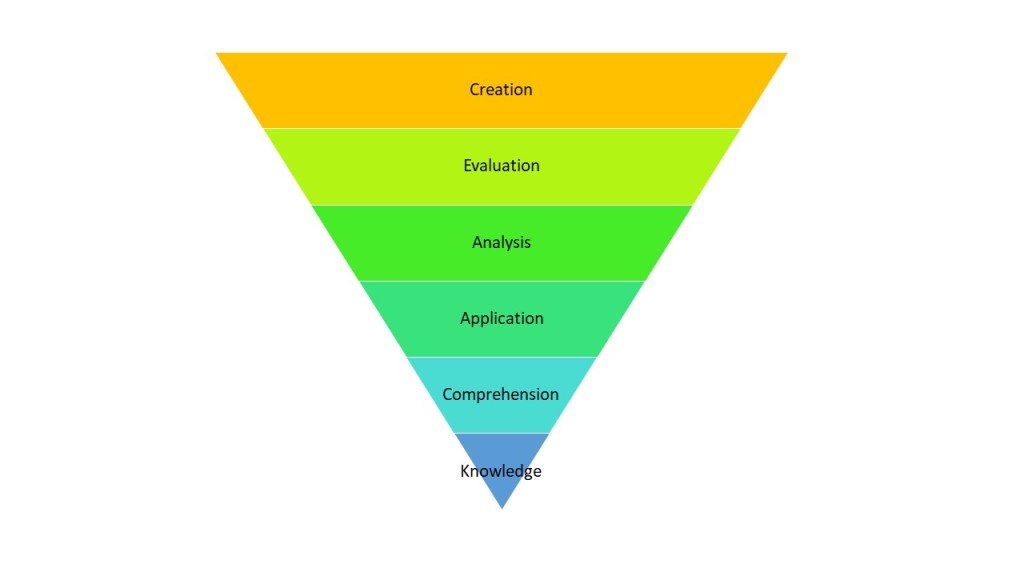
If you were trained in education, as I was, you probably learned about Bloom’s Taxonomy in college. Benjamin Bloom wrote his taxonomy of higher order thinking skills in the early 1950s and it has since been revised a bit.
The concept of this taxonomy is that knowledge is the lowest level of thinking. Synonymous with knowledge is memorization or recall. A lot of children (and adults) memorize scripture without fully understanding what it means, which is the next level.
Understanding is synonymous with paraphrasing, interpreting, translating, and comprehending scripture. You must have a good understanding to do all of these things. Moreover, you can understand a concept without applying it.
Application is the next level, and it is synonymous with re-enacting, displaying, prioritizing, supporting, proving, and otherwise thinking beyond the literal words to the impact of a scripture or concept. In Biblical terms, that means you know and can understand that Jesus saves and so you demonstrate that salvation a priority and repent and receive the free gift of salvation and apply it the way you live your life.
Knowledge, understanding (or comprehension) and application are all listed in the lower order of thinking skills. The higher orders of thought begin with analysis, which means breaking a concept into parts to examine it further. This can include steps such as comparing and contrasting, testing, making connections to similar concepts, asking probing questions, and so on. If you analyze a verse, you might circle the most important words, compare that verse to similar verses, discuss how they are the same or different, and more.
Going a step further is (this is a revision from the original taxonomy) evaluation. Evaluation means that you know what you believe well enough to defend your faith with substantial proofs, to critique erroneous thinking, and to make judgments about truth and falsehoods.
The final step is creation. This is posted as the pinnacle of the order of thought because it requires you to assimilate all that you have learned and then to respond. Pastors do this regularly when they deliver a sermon on a particular scripture. They have gone beyond knowledge, comprehension, and application to the higher orders and have analyzed commentary and other resources, evaluated the veracity of each and compiled an idea to share with the congregation based on their learning. This is the best teaching rather than simply parroting the ideas of others. Other equally valid means of creation include writing a book or thesis on a doctrine, composing song lyrics and setting them to worship music, creating a passion play (or something similar), illustrating a favorite scripture with an appropriate scene, or otherwise expressing an original thought about a scripture or text.
 From Peggy's Pen